
What Is a Disc Horn?
A disc horn uses a compact, flat housing. It is often chosen where installation space is tight, where a simple replacement format is preferred, or where buyers want a familiar horn design for broad vehicle coverage. Disc horns can be practical for mass-market replacement programs because the shape is easy to recognize and package.
OSUN's product listing includes an E-mark certified 12V disc horn, which makes the category relevant for buyers who need a straightforward horn option with documented quality positioning. In sourcing conversations, disc horns are often discussed around stable sound output, compact form, price positioning, and repeatable production consistency.
What Is a Snail Horn?
A snail horn uses a spiral or chamber-like shell that helps shape and project the sound. Many buyers associate snail horns with a fuller tone, stronger directional output, and more noticeable road presence. OSUN's product range includes multiple 12V snail horn models, including mini-shape, water-drainage, pure copper, and weather-resistant variations.
This makes snail horns useful for buyers who want a stronger product story: more distinctive tone, dual high/low combinations, climate-adapted shell design, or premium aftermarket positioning. HELLA and PIAA also present horn products around tone, vehicle application, and safety-device value, which shows how important sound character is in this category.
Key Buying Differences
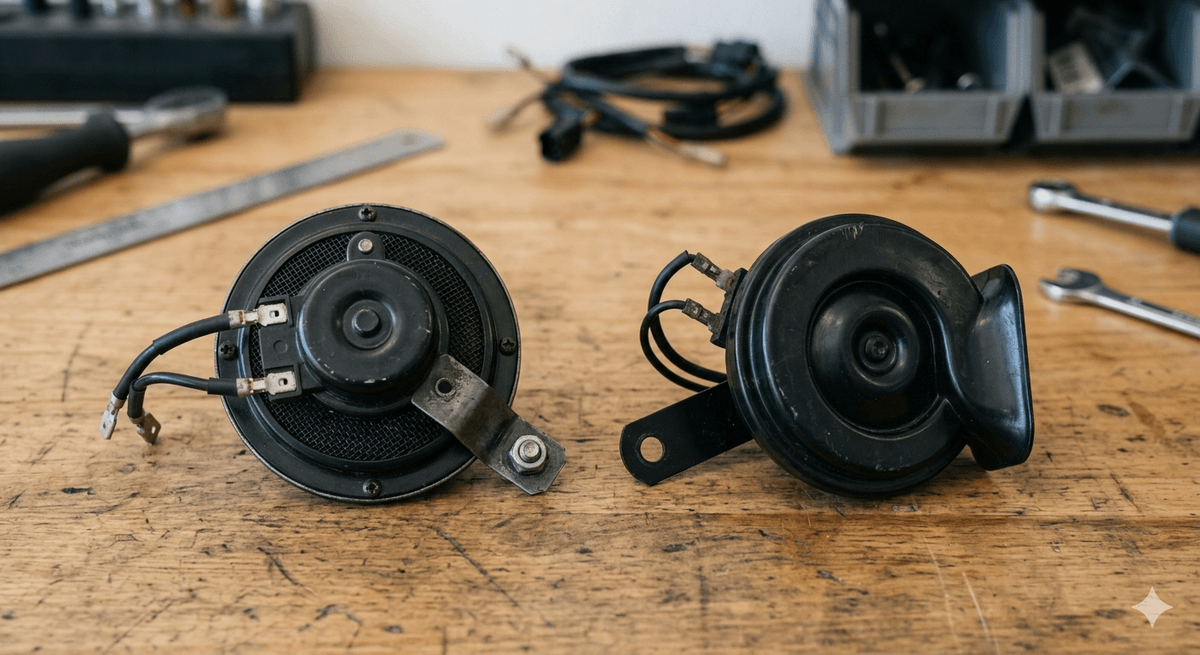
The buyer's decision should start with use case, not only product appearance. A disc horn may fit a value replacement program, while a snail horn may suit an upgrade-focused catalog. For mixed markets, carrying both types can help distributors serve different vehicle owners and installers.
- Sound character: Disc horns often support a clear, direct warning tone; snail horns are commonly chosen for a fuller or more powerful tone.
- Installation space: Disc horns are generally easier to position in tight areas; snail horns may need more attention to orientation and drainage.
- Weather exposure: Snail horn design should manage water and dust carefully; OSUN highlights water-drainage and weather-resistant shell ideas on relevant models.
- Catalog strategy: Disc horns can work well for standard replacement lines; snail horns can support premium, upgrade, or dual-tone packages.
- Buyer education: Snail horns often need clearer explanation of tone, direction, and mounting, while disc horns are easier to present as a simple replacement.
How OSUN Fits the Sourcing Decision
OSUN's company overview positions the company around R&D, production, and sales of automotive horns and wiper blades, with experience in both aftermarket and OEM-related markets. That matters because horn buyers are not only buying a sound device; they are buying consistency across batches, packaging support, and clear product differentiation.
For a distributor, disc horn vs snail horn can become a two-tier product strategy. A standard disc horn can cover everyday replacement demand, while a snail horn can serve drivers who want stronger tone, a more distinctive sound, or a more premium upgrade. The strongest sourcing decision is often not choosing one and rejecting the other, but matching each horn type to the right sales channel.
Conclusion

Disc horns are compact, familiar, and practical for standard replacement demand. Snail horns are more expressive, often more upgrade-oriented, and useful when tone and projection are part of the sales story. Buyers comparing disc horn vs snail horn should evaluate sound, mounting space, weather exposure, product positioning, and supplier support before placing orders.