
FIAMM AM80S horn searches often come from buyers who already know what a compact 12V snail horn should feel like: recognizable tone, controlled current draw, credible approval references, and a compact design that can fit common vehicle applications. For sourcing teams, that search can become a useful benchmark, but it should not become an unsupported replacement claim.
OSUN should be evaluated on its own product data and sample performance. Buyers can review OSUN's automotive horn products and compare specific snail horn models against the benchmark requirements. The goal is transparency: what is exact, what is similar, and what must be tested before approval.
What AM80S Searches Tell the Supplier
A buyer asking about FIAMM AM80S may be asking for several different things. They may need a 12V snail horn, an ECE/E-mark-oriented product, a high/low tone set, a compact body, a certain sound character, or a product that fits an existing catalog position. The supplier should clarify which of those needs matters most before suggesting OSUN alternatives.
FIAMM's AM80S product references and related horn pages are useful because they show the kind of data buyers expect: voltage, current, sound level, frequency, approval references, and product family details. That structure helps buyers make a disciplined side-by-side comparison instead of judging by sound impression alone.
OSUN Snail Horn Models to Review
OSUN's ODL-162 snail horn is a strong internal comparison point because the page highlights 12V E-mark positioning, powerful and pure tone, membrane filter technology, waterproof and exhaust performance, anti-corrosion surface treatment, and easy installation. Product imagery shows 12V 4A 110dB high/low tone markings with 500Hz and 400Hz examples.
OSUN's ODL-161 snail horn is another useful reference when installation space and drainage matter. The page highlights 65 mm slim thickness, water-drainage design, forward sound direction, and tough-weather positioning. ODL-165 can be considered when buyers want material and climate-related positioning, because the page mentions carbon-fiber-added pure-PP shell and stronger weather-resistant shell language.
Benchmark Checklist for Buyers
- Voltage and current: Confirm whether the OSUN sample marking matches the target 12V electrical requirement.
- Frequency pair: Compare high and low tone values, not only total loudness.
- Sound level: Test under the same distance, direction, and voltage before comparing dB values.
- Fitment: Compare body depth, bracket height, mounting hole, and horn mouth direction.
- Approval: Match E-mark or other certificates to the exact SKU and target market.
- Durability: Ask about drainage, membrane/exhaust design, anti-corrosion surface treatment, and sample testing.
- Packaging: Decide whether the product will be sold as single units, pairs, retail boxes, or bulk cartons.
Avoid Confusing the End Customer
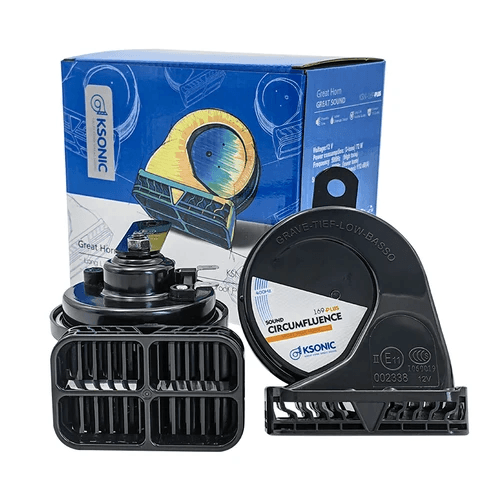
When a distributor uses AM80S demand to build a product line, the article and packaging should avoid implying that OSUN owns the FIAMM brand or supplies an identical product. A safer approach is to say that buyers can use AM80S-style requirements as a benchmark for reviewing OSUN snail horn samples. This keeps the comparison useful without creating brand confusion.
OSUN's company overview can support the supplier conversation by showing the company's focus on automotive horns, wiper blades, R&D, production, and sales. For a serious sourcing project, buyers should ask for sample markings, product drawings, packaging options, and any required documents together.
Conclusion
FIAMM AM80S horn searches are useful because they reveal a benchmark buyer mindset. The right response is not to overpromise direct equivalence, but to compare requirements: voltage, current, sound, frequency, fitment, approval, durability, and packaging. OSUN snail horn models such as ODL-162, ODL-161, and ODL-165 can be reviewed against those requirements through controlled samples and clear documentation.