
A high tone horn is not simply a horn that sounds sharp. For aftermarket buyers, the high tone is usually part of a pair. The high-frequency unit adds clarity and quick recognition, while the low-frequency unit gives the sound more body. If the pair is mismatched, the horn may be loud but unpleasant. If the fitment is poor, even a good horn can become a warranty problem.
OSUN's automotive horn products include disc, snail, and sports horn formats that can support different high/low tone strategies. The right choice depends on the buyer's channel: standard replacement, upgrade sound, compact fitment, or broader catalog coverage.
Frequency Pairing Is the Core Decision
Many horn product pages in the aftermarket talk about frequency pairs because buyers hear the final chord, not only one unit. PIAA lists performance horns with examples such as 400/500Hz, 500/600Hz, and 330/400Hz, showing how frequency changes the perceived tone. OSUN product images also show high/low tone examples. The ODL-151 disc horn images show a high tone around 420Hz and low tone around 350Hz, while several OSUN snail and sports horn images show high tone around 500Hz and low tone around 400Hz.
These values are useful for sample planning, but buyers should still confirm the exact SKU marking. A supplier may have several versions of a similar-looking horn, and the buyer's market may prefer a sharper, fuller, or lower sound.
Disc High Tone or Snail High Tone?
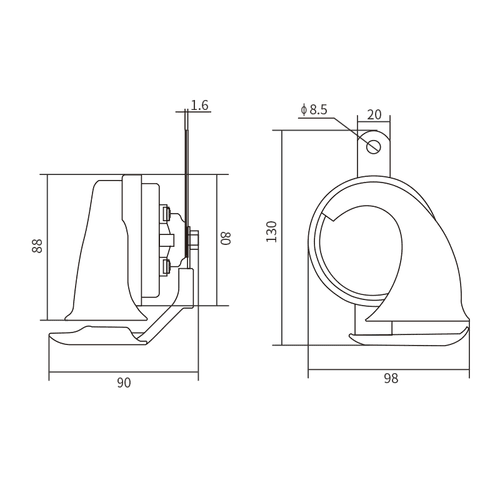
A disc horn can be a strong choice when the buyer needs compact installation and standard replacement positioning. OSUN's ODL-151 disc horn is positioned around compact size, sealing, crisp tone, and E-mark wording. Its product drawing shows a compact body and bracket dimensions that buyers can use during fitment review.
A snail horn is often selected when the buyer wants a fuller sound and a more directional horn mouth. OSUN's ODL-162 snail horn highlights membrane filter technology, waterproof and exhaust performance, anti-corrosion surface treatment, E-mark positioning, and 12V high/low tone markings visible in product imagery. This makes it useful for buyers who want a more premium 12V sound while still checking installation space.
What Buyers Should Verify Before Ordering
A high tone horn project should be approved with a small set of controlled checks:
- High/low pair: Confirm that the high tone and low tone are sold as a matched set when the catalog promises a dual-tone sound.
- Frequency marking: Record the frequency on the physical sample, not only the catalog page.
- Current draw: Check whether the horn is 3A, 4A, or another value and whether the wiring needs relay support.
- Sound pressure: Compare dB under the same distance, direction, and voltage, especially if packaging mentions loudness.
- Bracket fit: Measure mounting hole, bracket length, depth, and terminal direction before approving packaging.
- Documentation: If the product is sold as E-mark or ECE-related, match the document to the exact model and marking.
How to Position a High Tone Horn in a Catalog
For distributors, a high tone horn should not be sold only as "loud." Better catalog language explains the application: compact disc horn for replacement, snail horn for fuller dual-tone sound, sports horn for upgrade packaging, or multi-fit horn for coverage and installation convenience. HELLA's product range also separates horns by product type and application, which supports this more practical structure.
OSUN's company background can support supplier conversations when the buyer needs more than one model. The company overview positions OSUN around automotive horns, wiper blades, R&D, production, and sales. For a sourcing team, that means the inquiry can cover product selection, samples, documentation, packaging, and future catalog expansion together.
Conclusion
A high tone horn should be selected as part of a complete sound and fitment decision. Buyers should check frequency pair, voltage, current, sound pressure, bracket size, terminal format, weather resistance, and certification evidence. OSUN's ODL-151 disc horn and ODL-162 snail horn give two different directions for high tone horn programs, but the final approval should come from physical sample testing and market-specific fitment checks.