
A loud car horn is easy to describe but harder to approve responsibly. Importers and aftermarket brands want a horn that customers immediately recognize as strong, yet a simple "loud" claim can create problems if the sound test method, voltage, frequency, current draw, and installation position are not controlled. A horn that performs well in one sample video may feel different once it is mounted behind a grille, exposed to water, or connected through a weak harness.
OSUN's automotive horn range gives buyers several ways to build a loud car horn program, including compact disc horns, snail horns, sports horns, and multi-fit horn options. The best choice depends on whether the buyer is building a replacement line, a premium upgrade kit, or a broad repair-shop product.
Define What Loud Means for the Buyer

For some customers, loud means a clear warning sound in city traffic. For others, it means a deeper dual-tone upgrade that feels more premium than a standard single horn. For retail packaging, loudness may be part of the sales message, but for sourcing teams it must be translated into measurable points: dB value, test distance, test voltage, horn direction, high/low frequency pair, and installation condition.
PIAA's performance horn category and HELLA's horn references both show that tone frequency and horn type matter alongside sound level. A sharp high tone may cut through noise, while a matched high/low pair can sound fuller. This is why a buyer should compare the sound character instead of accepting a single number.
OSUN Models That Support Different Loud-Horn Programs
For a compact replacement line, OSUN's ODL-151 disc horn is a practical starting point. The page positions it around E-mark wording, crisp tone, sealing, and compact dimensions. Product images show 12V 3A and 110dB high/low tone markings, including 420Hz and 350Hz examples. Buyers should use those markings as sample-verification points, not as a substitute for their own testing.
For a fuller loud car horn, OSUN's ODL-161 and ODL-162 snail horns are more relevant. The ODL-161 snail horn highlights water-drainage design, 65 mm slim thickness, forward sound direction, and tough-weather positioning. The ODL-162 adds E-mark positioning, membrane filter technology, waterproof/exhaust performance, and anti-corrosion surface treatment. These features help buyers explain why the horn is not only loud, but also more practical for exposed automotive use.
Do Not Let Sound Claims Outrun the Evidence
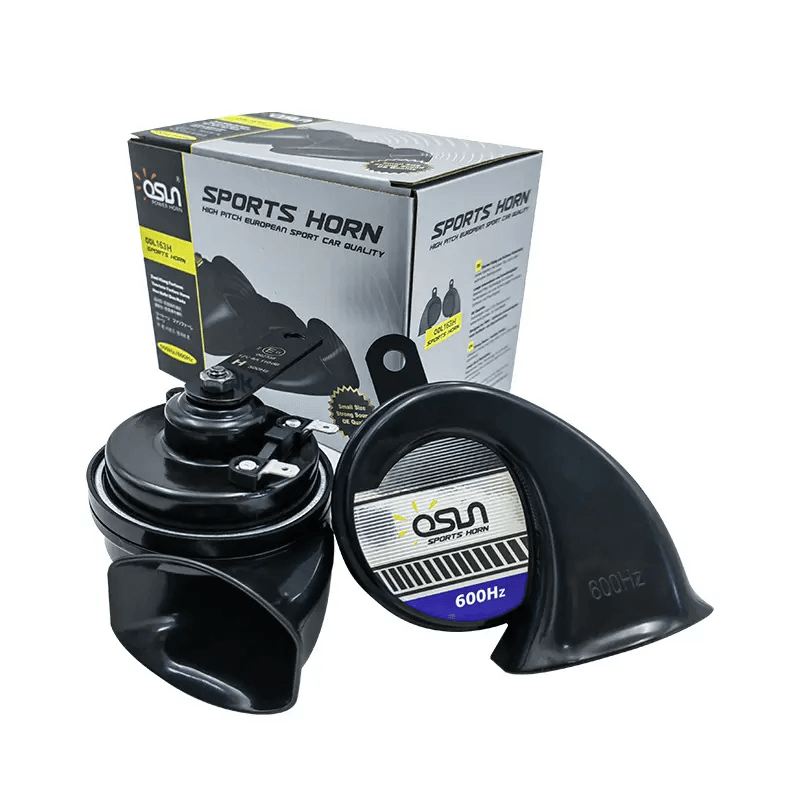
Some sports-horn pages may use stronger sound language, including high dB claims. Those claims can be useful for product positioning, but they should be handled carefully. If page text and visible product markings differ, the buyer should confirm the exact SKU marking, sample test method, voltage, distance, and certificate before using a dB value in retail packaging or online listings.
A good loud car horn approval pack should include:
- Photos of the front, rear, bracket, terminal, and product marking.
- Voltage and current draw during operation.
- dB reading with test distance and test environment recorded.
- High and low tone frequency, especially for dual-tone pairs.
- Mounting dimensions, including depth, bracket height, hole diameter, and horn opening direction.
- Certification evidence for the exact SKU when the target market requires it.
- Packaging wording that matches the verified sample, not only marketing language.
Position Loudness by Sales Channel
A repair-shop channel may prefer a dependable replacement horn that is easy to fit. A retail upgrade program may prefer a visually stronger sports horn or dual-tone snail horn. A distributor serving many vehicle models may care more about connectors and coverage, making OSUN's multi-fit car horn useful because the page highlights multiple adapters, stable connection, pure copper terminal, and low resistance.
This is where a loud car horn article becomes useful to real buyers. It should not only say "choose a loud horn." It should help them match horn type to market risk: sound complaints, fitment returns, wiring issues, water exposure, and certification questions.
Conclusion
A loud car horn should be approved with evidence. Buyers should compare OSUN disc, snail, sports, and multi-fit options by actual sound test, voltage, current, frequency, bracket fit, weather exposure, and documentation. Strong sound matters, but a horn becomes commercially useful only when the buyer can prove that the exact SKU fits the vehicle, matches the market claim, and performs consistently in the intended sales channel.