
A car horn connector adapter can preserve the factory harness and make replacement faster, but matching plastic shapes are not enough. The adapter must also have the correct pin assignment, polarity, terminal capacity, retention, sealing and wire size for the target horn circuit. A connector that locks securely can still be electrically wrong.
Begin With Both Sides of the Connection
Identify the vehicle-side connector and the horn-side terminal before choosing an adapter. Record the housing shape, key position, latch, cavity count, terminal width, wire colors and any seals. Photograph the original connector from several angles and compare it with a dimensional drawing rather than relying on a marketplace thumbnail.
Then check the circuit diagram. Some horns use two insulated terminals for power and ground. Others receive power through one terminal and ground through the metal bracket or case. Vehicles may switch the positive side, switch the ground side, or use a control module. An adapter must preserve the actual circuit logic.
How the OSUN Multi-Fit Concept Helps
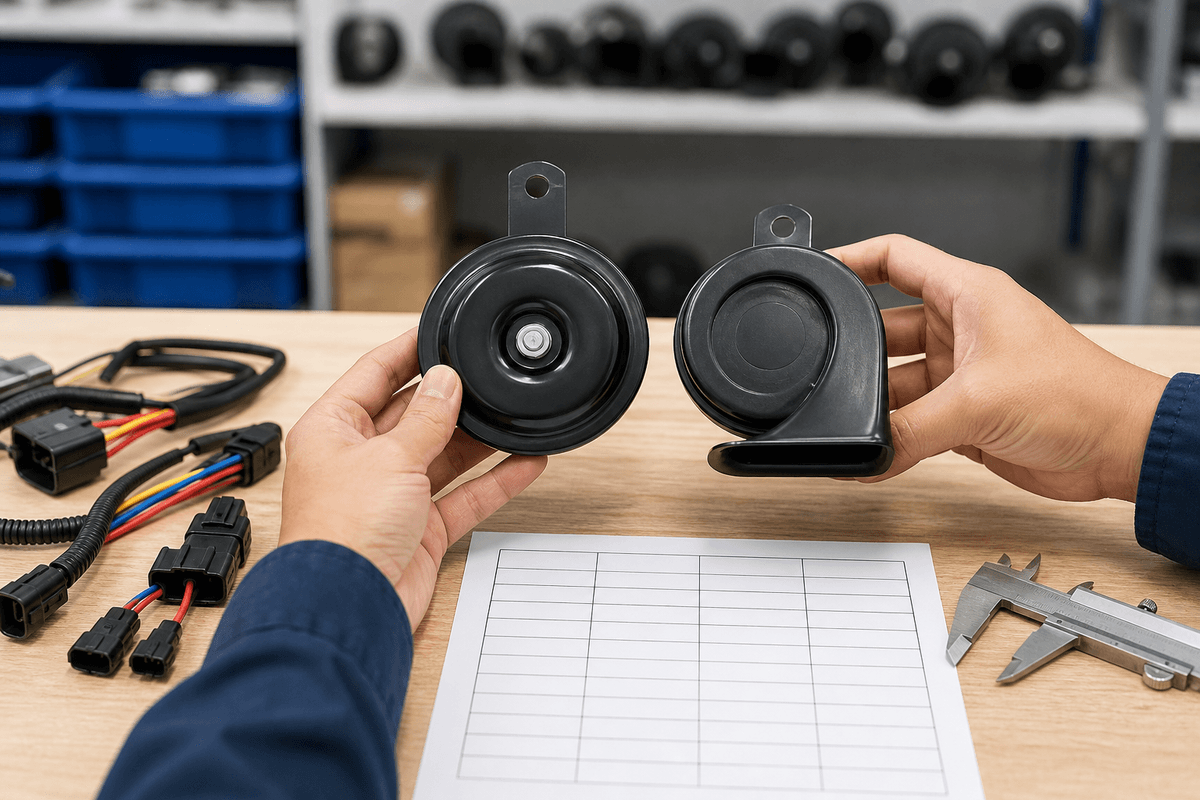
OSUN’s multi-fit car horn presents a 20-adapter system intended to reduce stock and broaden service coverage. The page highlights OEM-style connection, copper terminals, low resistance, stable connection and avoiding broken factory wires. For distributors, one horn platform with verified adapters can simplify inventory compared with carrying many vehicle-specific horn bodies.
The same page uses both 95% and 99% vehicle-coverage wording. Buyers should describe the concept as broad coverage and request the current adapter/application list instead of publishing either percentage as a universal guarantee. Vehicle generations, regional harnesses and production changes can affect fitment.
Adapter Qualification Checklist
- Housing mates fully without filing, forcing or removing a key.
- Latch engages and resists pullout under the specified force.
- Pin assignment and polarity match the vehicle circuit.
- Terminal material and plating support the expected current and environment.
- Wire cross-section is suitable for horn load and route length.
- Seals, backshell and strain relief suit the installation location.
- No exposed conductor can contact the body or nearby hardware.
- The adapter survives vibration, repeated connection and water exposure as required.
Test the Adapter Under Horn Load
A continuity beep only proves that a small test current can pass. It does not prove low resistance at several amps. Connect the actual horn, operate it briefly and measure voltage drop across the adapter. Inspect for unstable sound, intermittent contact and terminal heating after repeated cycles.
Current depends on the selected product. Reviewed imagery for the OSUN ODL-151 disc horn shows a 12V, 3A marking, while ODL-161 and ODL-162 snail horn images show 12V and 4A. Confirm the exact sample because one adapter specification should not be assumed suitable for every horn or dual-horn pair.
Do Not Let the Adapter Hide Other Fitment Problems
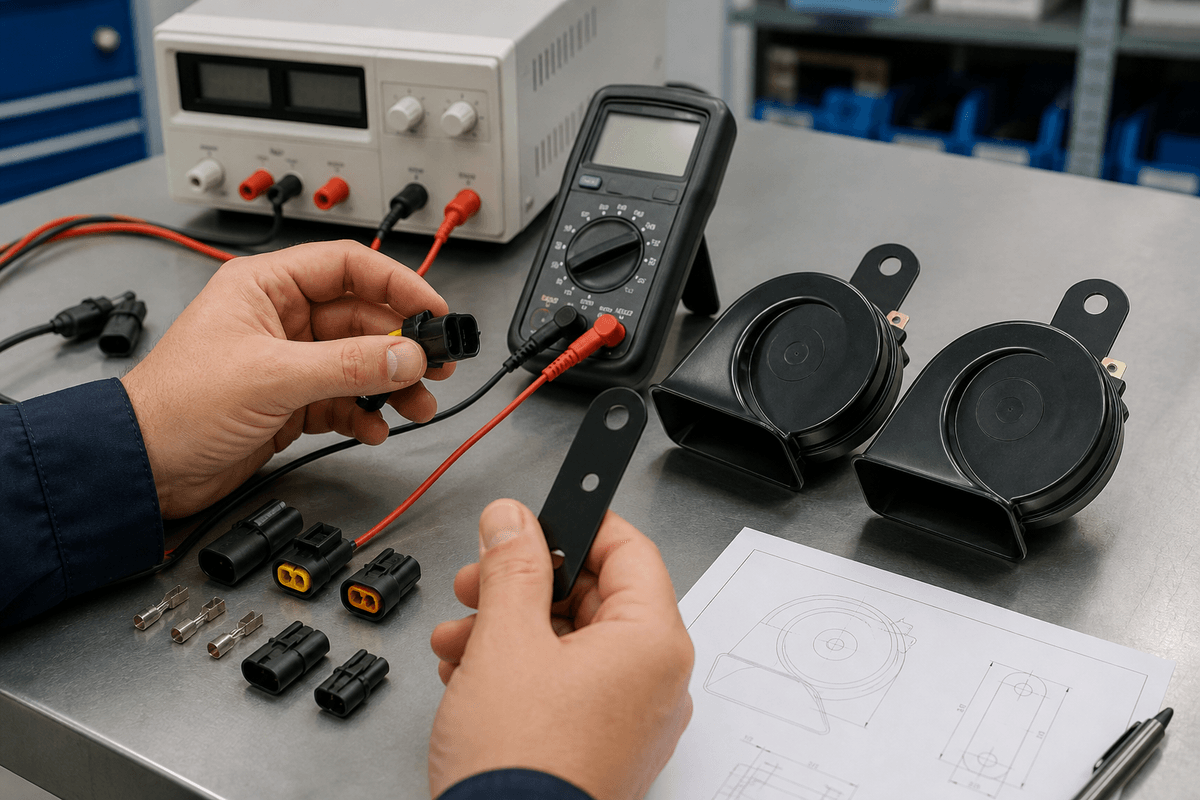
A correct connector does not guarantee physical fit. Measure the horn body, bracket hole, offset, terminal direction and clearance from the grille, radiator, body panels and moving parts. Confirm the outlet is not blocked and water can drain. If the replacement increases current, verify the factory fuse, relay, wiring and control-module output before installation.
HELLA’s workshop guidance recommends checking replacement-horn power consumption and whether the original wiring and protection remain suitable. It also treats examples as vehicle-specific, which is the right approach for adapter validation: document each confirmed application rather than extrapolating from a similar plug.
Build a Useful Application Database
For every approved vehicle, record market, model year, original connector photo, adapter code, pinout, horn model, mounting notes and electrical results. Link returns to this record so fitment data improves over time. Ask OSUN for adapter drawings, terminal specifications and samples through the contact page before finalizing a program.