
A car horn kit wholesale order passes through several teams before it reaches a distributor’s customers. The manufacturer prepares the chosen horn units, accessories and packaging. Purchasing approves the pack specification, and quality staff check the agreed contents before release. Use one versioned pack list to connect the quotation, packing sample and follow-on orders. The receiving records described below help verify that the factory and buyer are working from the same version.

Approve a car horn kit pack list with the factory
Start with the approved contents for the exact order. List every promised part by name, reference and quantity. Identify tone units separately when more than one is included, and note whether brackets, connectors, mounting hardware or electrical accessories are part of scope. A product family photo may show several options. Use the signed order specification and approved reference set to decide what belongs in the shipment.
Record how each part can be identified without assuming that its shape is unique. Labels, markings and reference photos can help receiving staff check parts that look similar. Where small items are supplied in a sealed bag, define whether the check applies to the bag label, its contents or both. Keep the reference accessible to the person actually opening cartons.
Before placing the order, ask which accessories are included in the quote and which require a separate line. If private-label artwork or a printed insert is part of the scope, request the approved version identifier and keep it beside the physical pack reference. Do not infer printing or customization availability from a stock product photo. Ask which options the manufacturer can quote for the actual order.
Compare the carton, retail box and contents
For a sampled car horn kit, match the outer carton label to the purchase order, then match the retail box and contents to the approved reference. Read the model suffixes and lot marks rather than accepting a similar-looking label. If a carton contains multiple variants, agree on how each is counted and record which boxes were checked.

Look for contradictions across the levels. For example, the outer carton may be labeled correctly while the retail insert belongs to another variant. An insert with an incorrect contents illustration can cause apparent shortages even when the order is packed correctly. Record whether each mismatch belongs to the product, accessory bag, printed material or carton label.
Identify paired components before counting a set
When two horns form a specified pair, record how the tones or part numbers are distinguished. A count of two proves the carton contains two units. It does not prove that they are the intended pair. Match each marking independently against the car horn kit specification and record the result.
Use the same method for hardware variants if the order specifies distinct brackets or connectors. Avoid relying on the material or color alone unless the approved identification system defines it. Put an identification example in the receiving instructions so an employee who did not attend the sample review can still check the kits consistently.
Define how to handle missing or unexpected items
Agree on the sampling approach and acceptance criteria before applying them to a shipment. If a car horn kit discrepancy is found, preserve the packaging and label, identify the affected carton and keep its contents separate. Record the missing item, the quantity expected and the quantity observed. Do not combine loose components from several sampled boxes before recording the evidence.
Decide whether to hold a carton, a batch or a shipment based on the agreed inspection process and traceability. A missing fastener in one box does not establish the extent of the problem. A repeated mismatch linked to the same packing lot may support a wider review. State what was checked and what remains unknown rather than treating every unopened box as defective.
Worked example: a correct horn and an incorrect accessory bag
Imagine the receiving team finds the specified high and low units in a car horn kit but an accessory bag with a different bracket reference. First photograph the markings on the horn units, the bag and the box. Compare the bag reference with the approved pack list to see whether the bag is an approved variant. If it is outside the specification, keep the package and record the carton and batch details before contacting the supplier.
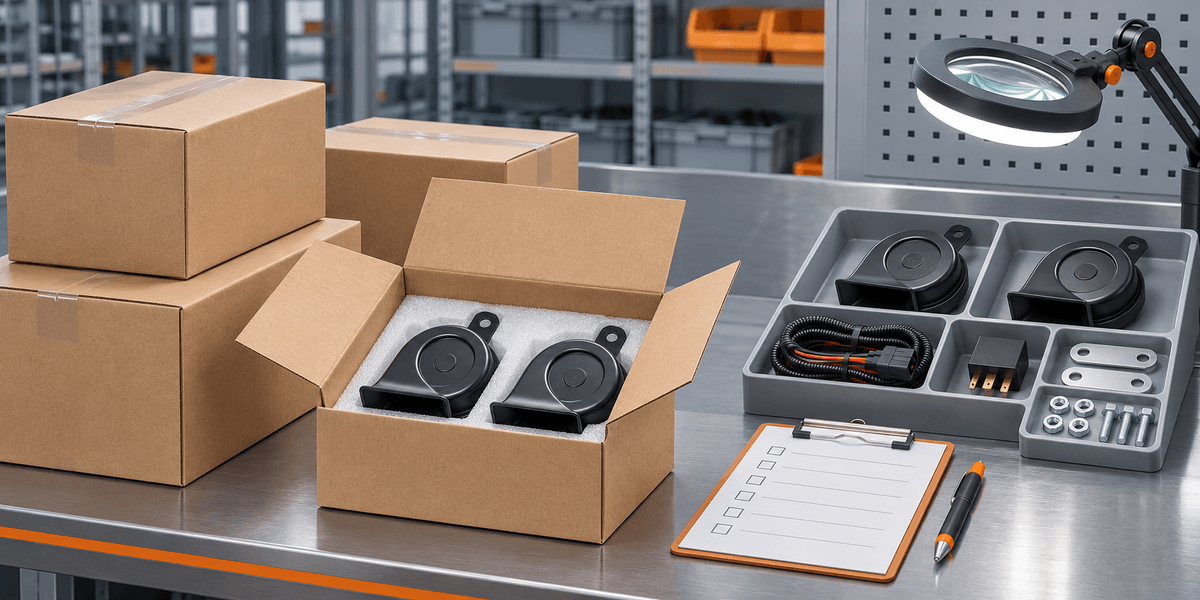
Use the inspection tray to keep verified components separate while counting. If the supplier confirms that a replacement accessory pack resolves the discrepancy, record the approved correction and which cartons receive it. Recheck the corrected boxes against the same pack list. Update the disposition for the original mismatch so that later claims can be traced to the right intervention. If the correction changes the supplied configuration, ask the buyer to review it before release.
Use shortage findings to improve the next factory order
Create a short form for customers who report missing car horn kit parts. Ask for the box label, purchased model, missing item and a single photograph of the contents if available. Keep this information tied to the original order. If a customer refers to a pictured component that is not in the agreed contents, compare the packaging artwork, sales listing and pack list before rejecting the complaint.
For repeat car horn kit orders, gather discrepancies by SKU and packing lot. If shortages often involve one item, review how its presence is checked and how the item is identified at packing. A clear difference between a real shortage and a mismatch in expectations helps a distributor give the supplier better feedback and improve the next order.
Questions about checking incoming kits
Should every car horn kit include a wiring harness?
Contents depend on the exact order. Compare what was supplied with the approved list for that model and sales channel. If a harness is optional, ensure the product listing does not describe it as included.
What if only one item in a pair can be identified?
Hold the sampled set for clarification and send photos of both marks. Ask for the exact identification rule and an updated receiving reference if the marks are hard to distinguish.
How can buyers confirm the configuration before ordering?
Use the OSUN automotive horn range to identify candidate product families and request an itemized pack list for the quoted configuration. Agree on individual markings, contents and packaging before approving the reference set.
Request a factory quote for the car horn kit
Share the car horn kit model references, required quantities and packaging details with OSUN. Mark which parts will be checked individually at receiving, and include the reference photos or drawings needed to confirm what each box should contain.