
Denso horns are a common reference point because many buyers associate DENSO with OEM-style quality, recognizable tone, and dependable automotive parts. For importers and aftermarket distributors, that search can be useful even when the goal is not to buy DENSO directly. It reveals what customers often care about: tone confidence, fitment, clear specifications, and reliable supply.
OSUN should not be described as DENSO or as an identical replacement. A better approach is to use Denso horns as a benchmark and then compare OSUN's automotive horn products through sample data, product drawings, and buyer requirements.
What Denso Searches Usually Mean
DENSO JHORN pages highlight practical categories such as 12V use, high and low tone combinations, sound pressure, frequency, and installation guidance. Those are exactly the categories a buyer should ask any supplier to clarify. A horn is not selected only by brand search; it is selected by how the sample fits the vehicle, sounds in use, and supports the target sales channel.
If a customer asks specifically for DENSO, the distributor should not hide that distinction. If the customer needs a benchmark sound or a similar product position, then OSUN samples can be evaluated transparently against those technical requirements.
OSUN Products to Compare Against the Benchmark
For compact replacement, OSUN's ODL-151 disc horn gives buyers a clear starting point. The page highlights compact design, sealing performance, crisp tone, and E-mark wording. Product images show 12V 3A 110dB high/low tone markings, including 420Hz and 350Hz examples.
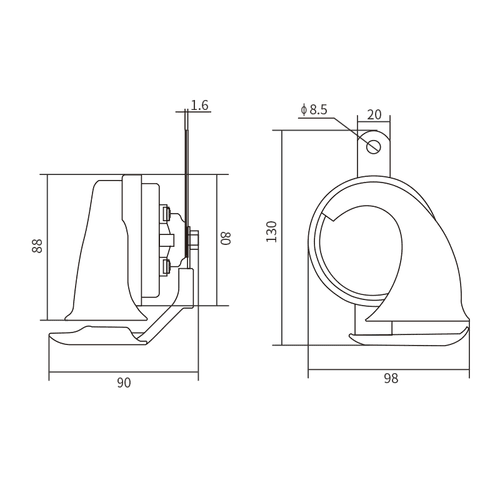
For a fuller dual-tone sound, OSUN snail horn models such as ODL-161 and ODL-162 are more relevant. ODL-161 highlights slim 65 mm thickness, water-drainage design, and forward sound direction. ODL-162 highlights E-mark positioning, membrane filter technology, waterproof/exhaust performance, anti-corrosion treatment, and 12V 4A 110dB high/low tone markings visible in product imagery.
Buyer Checklist for Denso-Horn Comparisons
- Brand requirement: Confirm whether the buyer needs DENSO specifically or a benchmark-style product.
- Voltage: Verify the 12V marking and operating condition.
- Sound: Compare dB value, frequency pair, and test method.
- Fitment: Check body depth, bracket hole, terminal direction, and horn mouth orientation.
- Durability: Ask about water drainage, sealing, membrane/exhaust design, and anti-corrosion treatment.
- Documents: Match E-mark or other proof to the exact OSUN SKU if required.
- Packaging: Decide whether the product will be sold as single horn, high/low pair, or retail kit.
How to Keep the Comparison Honest
The safest catalog language avoids direct equivalence unless there is verified evidence. Phrases like "Denso-style benchmark comparison" or "12V horn alternative sourcing checklist" are safer than saying one product is the same as another brand. This protects the buyer's brand, avoids customer confusion, and keeps the sourcing conversation focused on measurable data.
OSUN's company overview positions the company around automotive horns, wiper blades, R&D, production, and sales. That supplier background can support a B2B discussion when the buyer needs samples, packaging, and repeat supply rather than a one-time online purchase.
Conclusion
Denso horns are useful as a benchmark because they point buyers toward serious comparison categories: voltage, sound, frequency, fitment, durability, documents, and packaging. OSUN disc and snail horn models can be reviewed against those categories, but the final decision should be based on exact samples and honest product positioning rather than brand-name assumptions.