
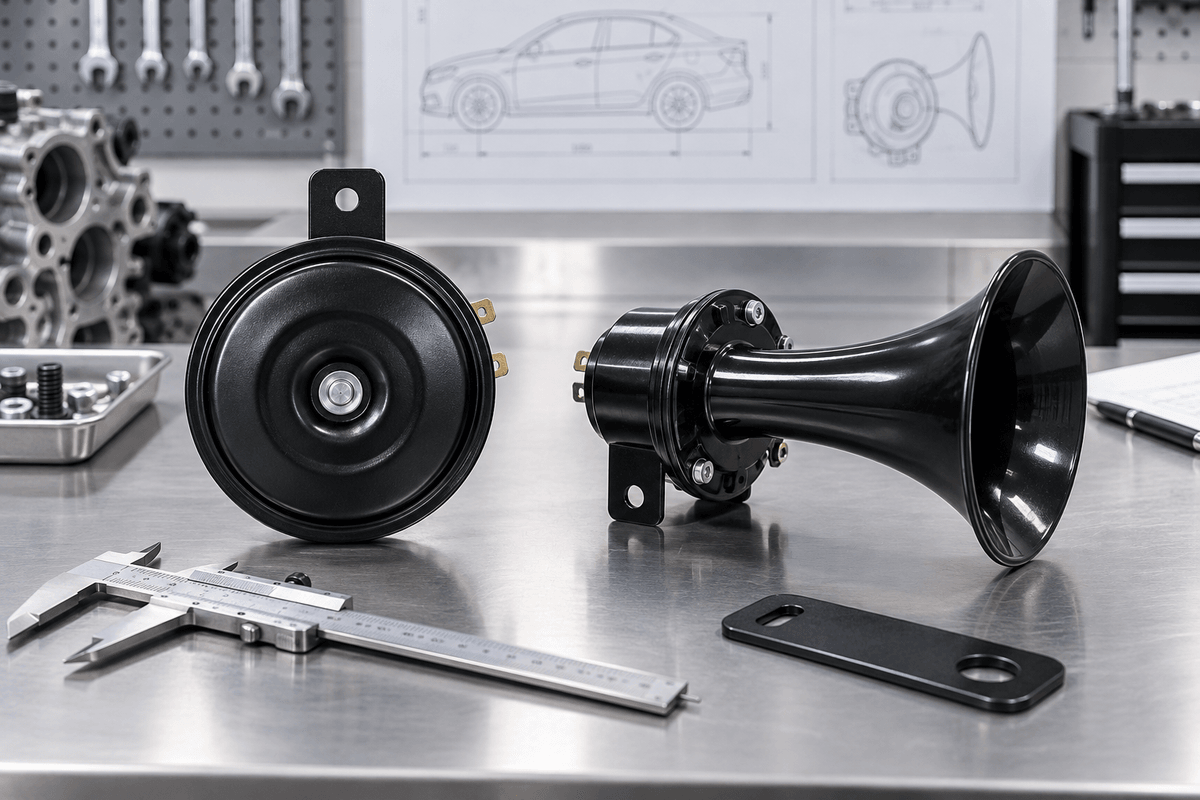
Disc horns and trumpet horns can both provide an effective vehicle warning, but they package and shape sound differently. A disc horn places a vibrating diaphragm in a compact round body. A trumpet-style electric horn uses a shaped outlet or resonating path to influence radiation and tone. The choice should follow available space, sound requirement, environmental exposure and electrical design.
Comparison at a Glance
| Decision point | Disc horn | Trumpet-style horn |
|---|---|---|
| Package | Usually compact and shallow | Requires room for the outlet or channel |
| Sound radiation | Often more bundled or direct | Often wider and fuller, depending on design |
| Water management | Sealing and body position matter | Open end and drainage orientation are critical |
| Best use | Tight spaces and straightforward replacement | Tone-led applications with sufficient clearance |
HELLA describes disc horns as space-saving with bundled sound radiation, while trumpet horns provide wider radiation and a fuller, more harmonious character. These are useful category tendencies, not guarantees for every model. Buyers should compare exact samples using the same voltage, mounting fixture, distance and acoustic environment.
A Compact Disc Example From OSUN

The OSUN ODL-151 is positioned as a compact 12V disc horn. Its reviewed drawing shows approximately 76mm diameter, 47mm depth, 105mm overall bracket height and an 8.5mm mounting hole. A visible product marking shows 12V, 3A, 110dB and high/low versions at 420Hz and 350Hz.
Those values create a practical qualification list: measure the cavity, verify bracket position, check current capacity, match the chosen frequency and request the certificate for the exact SKU. The marking should be treated as product identification to confirm under a defined test method, not as a universal installed sound result.
Trumpet and Snail Designs Need an Open Sound Path
A snail horn is a compact coiled form of a resonating horn path and shares several installation concerns with trumpet-style units. The OSUN ODL-161 page emphasizes a 65mm slim package, forward sound direction and drainage design. Its opening must not be blocked by trim, and its orientation should avoid collecting water.
PIAA’s installation guidance similarly warns installers to protect sports horns from direct water spray and dust, keep them away from hot engine components, and orient the open end downward. Always follow the instructions for the actual product rather than applying one brand’s exact installation rule to another model.
Questions to Answer Before Sampling
- What are the maximum width, depth and bracket envelope?
- Is a focused warning or a wider, fuller sound preferred?
- Will the outlet face open air or a blocking panel?
- Where can water enter, drain or become trapped?
- What voltage, current, frequency and connector does the vehicle require?
- Does the destination market require approval evidence for this exact type?
- Is the catalog item a single unit or a matched high-low set?
Make the Final Decision on the Vehicle
Bench tests help compare tone and consistency, but the installed vehicle changes sound through shielding, grille openings, body resonance and supply voltage. Install representative samples on production-like brackets, test voltage drop and current, and confirm no contact during vibration. For OSUN model drawings, connector options and samples, use the contact page.