
People searching for the legal decibel limit for a car horn often expect a single maximum value. In practice, there is no universal number that can be applied to every country, vehicle category, horn type, and test setup. A horn may carry a 110 dB product marking, yet a regulatory measurement can produce a different result because the microphone distance, supply voltage, acoustic environment, frequency range, and whether the horn is tested alone or on a vehicle all matter.
Start With the Target Market, Not the Catalog Number

UN Regulation No. 28 is an important approval framework for audible warning devices in many markets. It specifies controlled acoustic and durability tests, including a defined microphone position and test environment. National road-use and inspection rules may add separate requirements. Other countries use their own federal, state, provincial, or local rules. A distributor should therefore identify the destination market and vehicle category before deciding whether a horn is compliant.
A useful compliance brief should state:
- The destination country and any regional variations.
- The vehicle class and whether the product is original equipment or an aftermarket replacement.
- The applicable approval regulation and required certificate version.
- Whether the limit applies to the device, the installed vehicle, road use, or all three.
- The prescribed test distance, voltage, weighting, and acoustic conditions.
Why 110 dB on a Horn Is Not a Legal Conclusion
Several OSUN product images show electrical and acoustic markings such as 12V, 110 dB, and high/low frequency values. For example, the ODL-151 disc horn is shown with 12V, 3A, 110 dB and 420/350 Hz markings. The ODL-161 snail horn is shown with 12V, 4A, 110 dB and 500/400 Hz markings. These are useful for sample identification and electrical planning, but buyers should not compare them with a legal limit until the measurement method is known.
Sound pressure falls with distance, while reflections can increase a reading. Battery voltage and current delivery influence horn output. A handheld reading close to the horn in a workshop cannot replace a type-approval test in a controlled environment. Treat the printed value as a specification to verify, not proof that every installation is legal.
A Practical Sample-Approval Routine
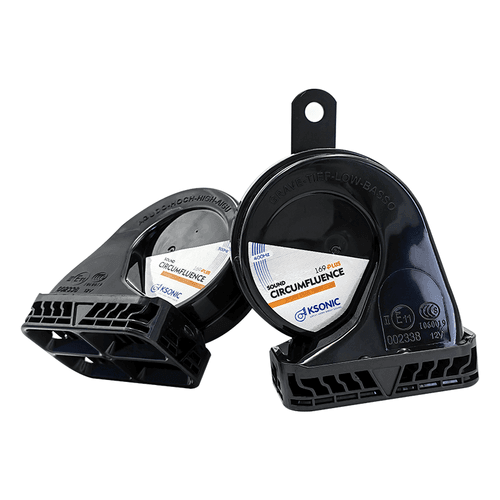
Before releasing an order, request the exact SKU drawing, product marking, approval certificate, and test report. Confirm that the approval mark on the sample corresponds to the certificate and that the product family, voltage, and variant are covered. Then conduct an incoming check at the specified voltage and record the meter type, distance, orientation, background noise, and result. This creates a repeatable benchmark for future lots.
Installation matters too. The horn outlet should not be blocked by trim or pointed into a water trap. Wiring, fuse, relay, grounding, and bracket rigidity must support the product’s current and vibration requirements. OSUN’s ODL-161 highlights a 65 mm slim body, water-drainage design, forward sound direction, and an 8.5 mm mounting hole; those details help buyers evaluate fitment without converting a catalog claim into a compliance guarantee.
Questions to Send With an RFQ
- Which regulation and amendment level applies to this exact horn?
- What are the rated voltage, current draw, tone frequencies, and test sound level?
- At what distance and voltage was sound pressure measured?
- Does the supplied approval mark match the certificate and production sample?
- Can OSUN provide samples for vehicle-level verification?
The safest purchasing decision is based on traceable evidence for a named market and SKU. Buyers can review OSUN’s horn product range and send the vehicle, market, connector, and approval requirements through the contact page.