
ECE R28, formally UN Regulation No. 28, concerns the approval of audible warning devices and motor vehicles with regard to their audible signals. For an importer, the useful question is not simply “Is this horn E-marked?” It is whether the exact production type, approval documentation, marking, and test conditions align with the product being purchased and the rules in the destination market.
What the Regulation Evaluates
The regulation distinguishes between approval of the warning device and requirements for the audible signal when installed on a vehicle. Device type is defined by characteristics such as operating principle, casing and outlet shape, diaphragm dimensions, rated frequency, rated supply voltage, and, for pneumatic devices, operating pressure. A substantial product change can therefore affect whether an existing approval still covers the variant.
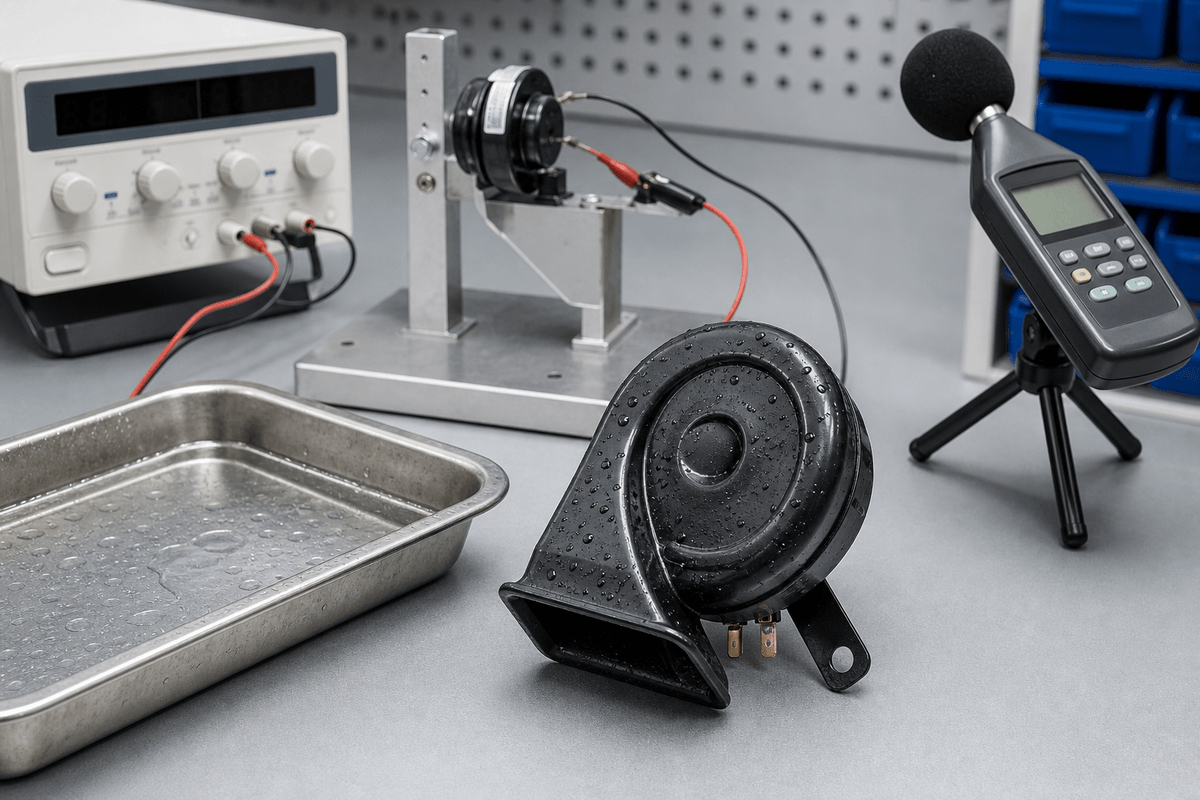
Acoustic testing is controlled rather than casual. The regulation describes an anechoic, semi-anechoic, or suitably prepared open test space, limits background noise, specifies microphone alignment and distance, and calls for precision measuring equipment. The warning device must produce a continuous and uniform sound. Durability and post-endurance performance are also part of the approval logic.
The Evidence Chain a Buyer Should Follow
- Identify the exact model, voltage, tone configuration, and physical version offered.
- Obtain the approval certificate and its annexes, including extensions where relevant.
- Match the approval number and mark to the sample and packaging documentation.
- Check whether product drawings and rated characteristics correspond to the approved type.
- Agree on production inspection records and change-control notification.
An approval logo in a brochure is not enough. Buyers should ask for legible evidence and confirm which approval authority issued it. They should also distinguish an E-mark associated with UNECE type approval from an EU e-mark and avoid using the terms interchangeably in product listings.
Applying R28 Questions to OSUN Models
The OSUN ODL-151 disc horn is positioned as a 12V E-mark product. Its visible product details include an approximately 76 mm body width, 47 mm depth, 8.5 mm mounting hole, and a marking showing 12V, 3A, 110 dB, with high and low tones indicated at 420 Hz and 350 Hz. Those details give a buyer concrete fields to match against a drawing, sample, and certificate.
For a snail-horn program, the ODL-162 page references E-mark positioning, an anti-corrosion finish, membrane filter technology, and a visible 12V/4A high-low tone marking. Procurement should verify that the exact sample and certificate cover the ordered variant. Promotional lifespan language should be replaced in the purchase specification with a defined cycle test and acceptance criteria.
Turn Approval Into a Production Control
R28 sourcing is stronger when certificate review is connected to incoming inspection. Define a golden sample, photograph its marking, record dimensions and electrical characteristics, and agree on limits for frequency, current, and acoustic output under a repeatable method. Require notification before changes to the shell, diaphragm, coil, resonator, terminals, or rated voltage.
Installation also needs attention. Bracket stiffness, outlet direction, connector resistance, supply voltage, and grounding can affect vehicle-level performance. A compliant device does not excuse a poor installation, and a loud workshop test does not establish type approval.
R28 RFQ Checklist
- Exact model and rated voltage covered by the certificate.
- Approval number, authority, amendment level, and extensions.
- Sample marking and drawing matched to the certificate.
- Acoustic, electrical, endurance, corrosion, and water-exposure test evidence as applicable.
- Production consistency plan and documented change control.
OSUN presents experience in horn development and manufacturing on its company overview. Buyers should still qualify each SKU individually and use the contact page to request current documents for the target market.