
E-mark car horn certification is valuable only when the approval can be traced to the actual product supplied. A mark in a sales image, a certificate for a related model, or a test report without product identity can leave an importer exposed. Effective verification connects five items: the destination-market requirement, approval certificate, product marking, technical definition, and production sample.
First, Clarify What the Mark Represents
UN Regulation No. 28 provides a type-approval framework for audible warning devices and vehicle audible signals. The capital “E” marking commonly associated with UNECE approval identifies an approving contracting party through its number; that number is not a performance grade. Buyers should also avoid confusing this mark with a lowercase EU “e” approval used under a different legal framework.
Because regulations and market acceptance change, importers should confirm current requirements with the responsible authority or qualified compliance professional in the destination country. Certification should be treated as market-specific evidence, not a universal sales claim.
Five Checks Before Approving a Supplier
| Evidence | What to match | Typical risk |
|---|---|---|
| Certificate | Approval holder, regulation, number, model and extensions | Certificate belongs to another variant |
| Product mark | Approval number, voltage and model identity | Unclear or inconsistent marking |
| Drawing | Housing, outlet, bracket, dimensions and terminals | Physical type differs from approval |
| Test evidence | Acoustic method, endurance and rated conditions | Marketing data replaces controlled testing |
| Golden sample | Marking, dimensions, current, frequency and sound | Production drifts after approval |
Use Product Details to Test Traceability
The OSUN ODL-151 is presented as a 12V E-mark disc horn. Its reviewed product drawing indicates roughly 76 mm diameter, 47 mm depth, a 105 mm bracket height, and an 8.5 mm mounting hole. A product image shows 12V, 3A, 110 dB and 420/350 Hz markings. A buyer can use these fields to check whether the offered sample, drawing, and approval file describe the same model.
The ODL-162 snail horn is another E-mark-positioned example. Its page highlights membrane filtration, water exhaust behavior, and anti-corrosion treatment, while its visible marking indicates a 12V, 4A high/low tone configuration. Those commercial features still need separate purchase requirements; an E-mark approval does not automatically validate every corrosion, waterproofing, or lifespan claim.
Build Certification Into the Purchase Order
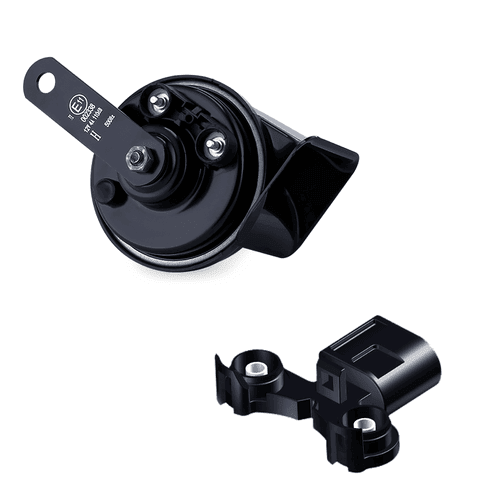
State the exact approved model, voltage, marking, certificate number, drawing revision, and packaging label in the order specification. Define how substitutions and engineering changes will be handled. For ongoing supply, compare incoming lots with the golden sample and keep photographs and measurements tied to batch records.
- Reject approval files with unreadable numbers or missing annexes.
- Ask whether the certificate holder and manufacturing site relationship is documented.
- Confirm whether high-tone, low-tone, and paired products are all covered.
- Specify current draw, frequency, sound test method, terminal, and bracket checks.
- Require written notification before materials or construction change.
Buyers can review OSUN’s available horn categories and request current model-specific documentation through OSUN’s contact page.