
A piezo horn is not automatically a suitable replacement for a vehicle's external warning horn. Before ordering, check the exact part's intended application, electrical input, mounting and acceptance requirements. A sounder that produces an alert on a workbench has not yet demonstrated that it fits the vehicle or performs the required warning function.
For an automotive importer or aftermarket distributor, the practical question is which replacement to source for the vehicles being serviced. OSUN lists automotive disc and snail horns, including the ODL-151 disc horn. This guide explains when to move from a generic piezo horn enquiry to a model-specific automotive horn enquiry, and what to ask OSUN to confirm before selecting a sample.
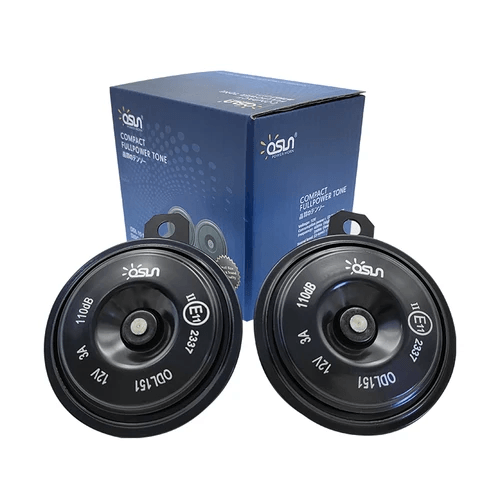
OSUN ODL-151 automotive disc horns. Official product photograph from the ODL-151 product page; not a photograph of a piezo sounder.
First distinguish the technology from the application
“Piezo” describes how a device generates vibration. “Automotive” describes where and how a component is used. These categories can overlap: piezoelectric sounders are used in vehicle alerts, including powered-door applications. That does not establish that an equipment buzzer is interchangeable with an external road-warning horn. The exact product and its documented function decide the application.
A piezoelectric element moves when an electrical signal is applied. Some assemblies incorporate a drive circuit; others require an external driver, as explained in Murata's sound component guidance. Common electromagnetic automotive horns use an electrically driven diaphragm. Neither a catalogue category nor the word horn provides enough information to approve a substitution. Identify whether the original component is an equipment alert, a vehicle status buzzer or the driver's external warning horn.
When does the enquiry belong with OSUN?
OSUN is relevant when you are sourcing an automotive warning horn and need to compare its published product models against your installation requirements. Start with the OSUN automotive horn range, which includes disc and snail designs. The range page directs buyers to prepare voltage, installation space, connector type and target sound characteristics before requesting a quotation.
The reason to contact OSUN is to resolve those requirements against a named model, rather than buy whichever item appears under piezo horn in a search. An importer can ask which listed automotive horn should be evaluated for a defined replacement programme. A distributor can ask what must be confirmed before adding that model to an assortment. Model selection still requires supporting specifications and sample checks.
If your requirement is a piezo element for a control board, an enclosure buzzer or a powered-door alert, the OSUN pages reviewed for this guide do not establish a matching piezo product offering. Identify that requirement separately. An automotive horn enquiry should describe the external warning function rather than imply that every sound-producing component is part of the same product family.
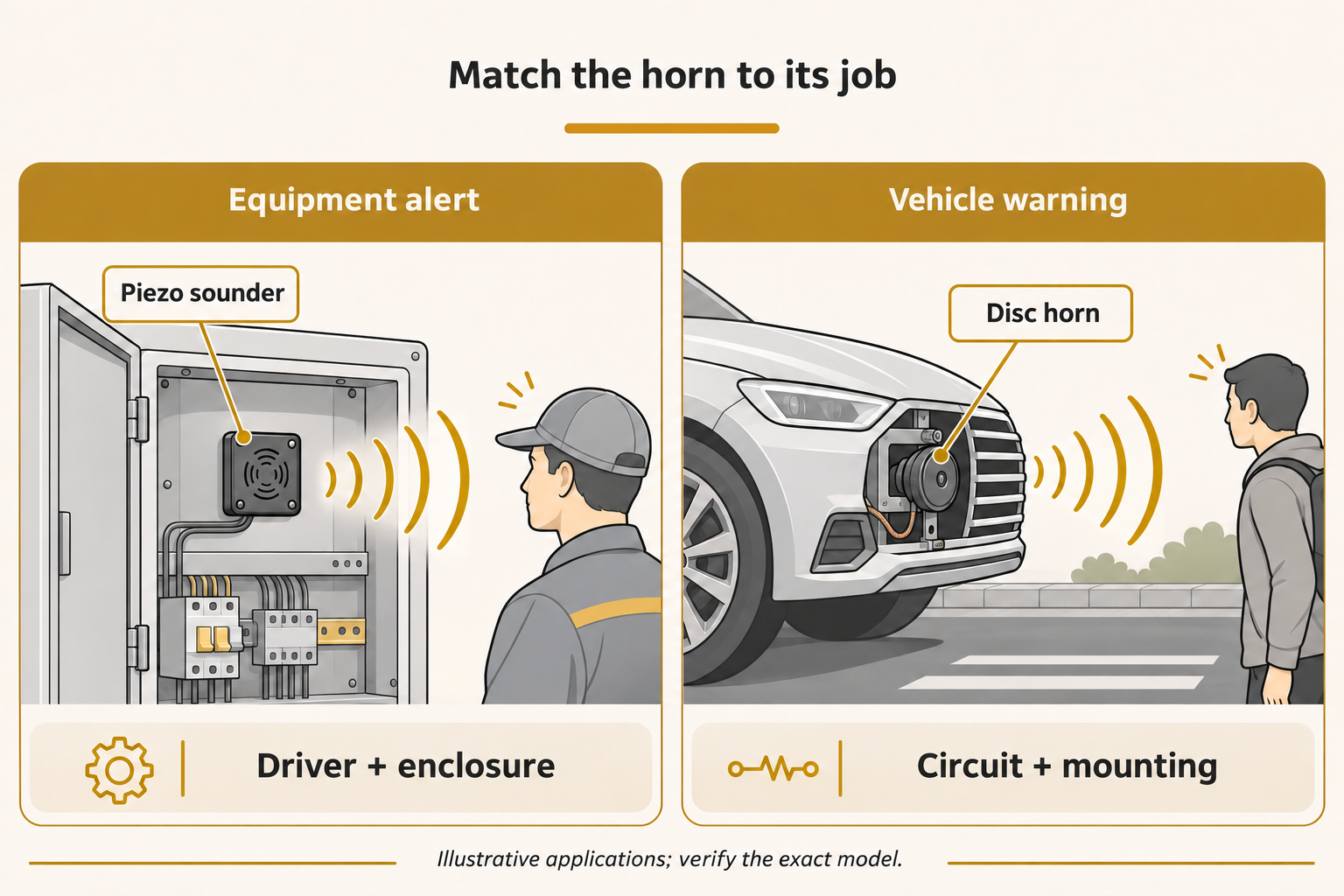
Illustrative applications, not mutually exclusive technology categories. Confirm the intended function of the exact model. Tap image to enlarge.
Check four requirements before selecting a replacement horn
1. Intended warning function
Record who must hear the signal and what it tells them. An alert directed at a nearby operator and a warning intended for other road users have different installation contexts. For the vehicle replacement, identify the original horn reference and the vehicle application. Ask for the requirements that apply in the destination market; do not infer suitability from the product name.
2. Input and circuit load
For a piezo horn, establish whether the assembly accepts a supply directly or needs a particular drive signal. For the automotive replacement, compare the vehicle supply and circuit arrangement with the selected horn's documented requirements. A matching connector does not prove that the circuit can support the load. Have the responsible installer review the vehicle documentation before changing the electrical arrangement.
3. Mounting and exposure
Compare the bracket, available clearance, connector access and installed orientation. Include photographs of the original part in place, not only a loose component on a desk. Nearby trim or the grille can affect the sound path. Ask the supplier which mounting conditions and environmental limits are documented for the proposed model, then check that the installation stays within them.
4. Sound measurement and acceptance
A listed sound-pressure figure needs its measurement distance, supply conditions and setup before it becomes useful for comparison. Evaluate the sample in a representative installation as well as reviewing its data. A louder phone recording is not evidence of vehicle suitability. Keep the applicable vehicle requirements distinct from subjective preferences about the sound of the horn.
Use ODL-151 as a model-specific starting point
The OSUN ODL-151 disc horn is a concrete starting point when a buyer is considering a disc-style automotive warning horn. Its published page identifies the product and describes a compact disc design. Treat that as a product reference for a supplier discussion, not proof that it replaces your existing component.
Send OSUN the original part reference, vehicle details and mounting photographs, and ask whether ODL-151 is a suitable sample candidate. Request the exact electrical data, connector drawing and mounting information needed for your comparison. Do not borrow current, frequency or sound-level figures from another OSUN model. Specifications belong to the model and version being offered, even when the products look similar.
If the installation requires another configuration, ask OSUN to identify an alternative within its automotive horn range and explain what changes in the comparison. A disc or snail housing alone does not establish compatibility. Keep the enquiry centred on the vehicle requirement so that the response identifies an actual part to evaluate, rather than a general assurance about the range.
Turn an unclear request into a useful product comparison
Suppose your customer sends a photograph labelled piezo horn, but the actual request is to replace the external horn on a service vehicle. Ask for the original part marking and an installed photograph before choosing a catalogue item. Establish the vehicle circuit requirements and available space, then send those details with the enquiry. If a disc horn is being considered, ODL-151 provides a named OSUN reference to discuss. If the original item is actually a door alert or equipment sounder, keep it out of that comparison. This first distinction prevents a quotation for the wrong function and gives the supplier a specific application to evaluate.
Send an enquiry that OSUN can evaluate
Make the first enquiry specific enough to distinguish your application from a generic sounder purchase. Include the vehicle or replacement programme, original part reference, required supply, mounting space and connector photographs. State the destination market and any approval documents your customer requires. If you have only a piezo horn listing as a reference, explain which details are known and which remain unverified.
Ask OSUN to respond with a proposed model, the supporting specifications and the information still needed from you. For commercial planning, request quantity-dependent pricing, sample availability, packaging and lead time rather than assume these from a product page. These are enquiry items, not commitments made by this guide. Review the technical response before treating a quotation as evidence that the installation has been approved.
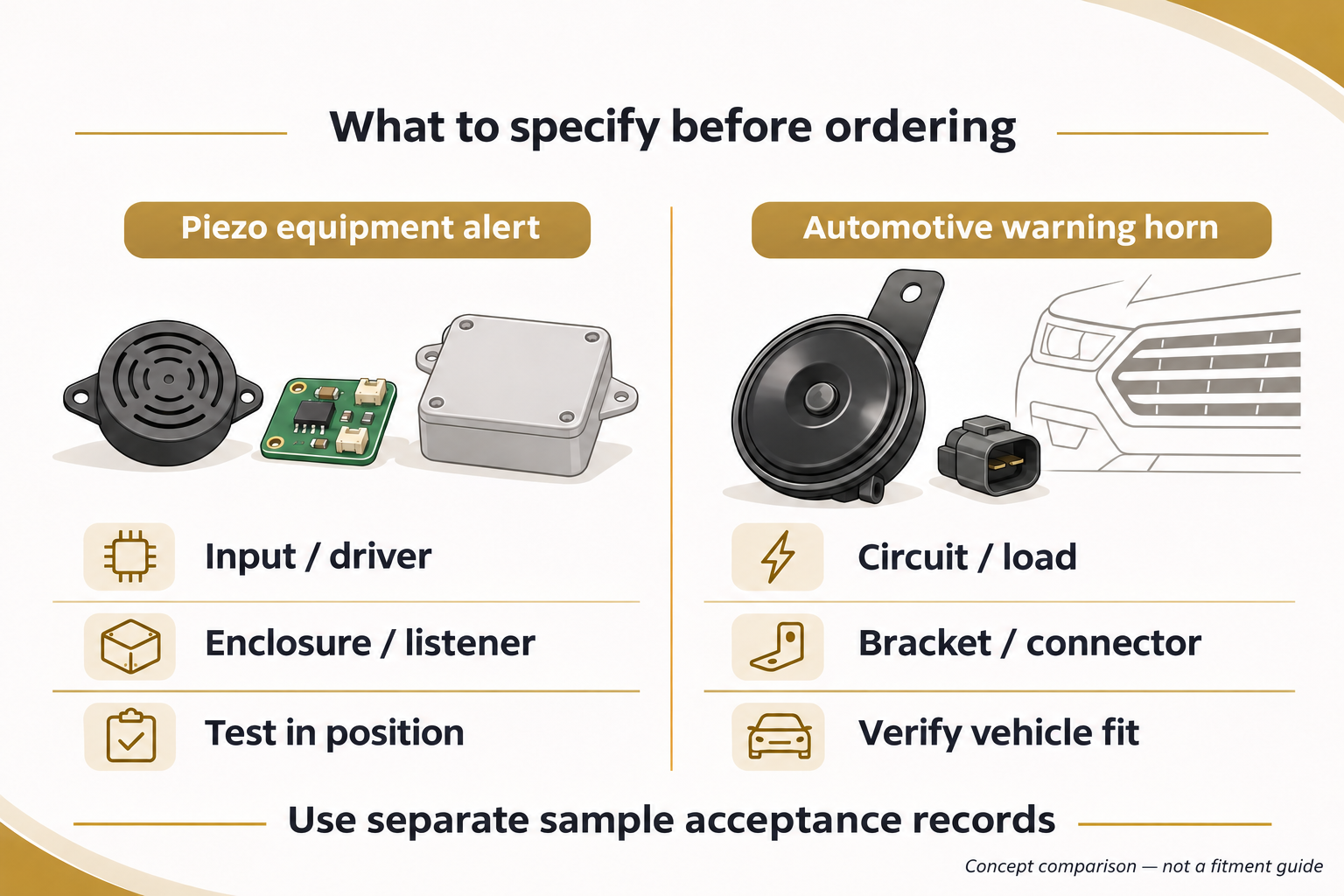
Concept comparison, not a fitment guide. Verify the input, mounting and acceptance criteria for the exact application. Tap image to enlarge.
Questions before requesting an automotive horn sample
Does a piezo horn necessarily mean a non-automotive product?
No. Piezo describes the sound-generation principle, and automotive describes an application. A piezoelectric device can have an automotive use. The relevant question is whether that particular device is documented for the warning function and installation you need, not whether its technology appears in another vehicle component.
Can a connector match justify a direct replacement?
No. Review the electrical requirements, mounting, sound path and intended warning function as well. A connector is one interface in the comparison. Ask the installer and supplier to resolve missing information before approving a sample for a vehicle application.
What should I ask OSUN to confirm first?
Ask which named automotive horn model should be evaluated against your original part and installation details. Then request its relevant specifications and sample information. This makes the next step a defined product comparison rather than an assumption that a generic piezo horn and a vehicle warning horn are interchangeable.
Discuss your automotive warning horn requirement
If you need a vehicle warning horn, send OSUN your application, original part details and installation photographs. Ask for a proposed automotive model and the specifications needed to evaluate it before ordering.